Category: Politics

  • Today was a bad day

    First, let’s acknowledge that this was a terrible day for two West Virginia National Guardsmen, who as of this writing are still fighting for their lives after being shot at close range in Washington D.C. And a gut-wrenching day for their families, who were likely preparing for their Thanksgiving holiday, hoping to at least talk on the phone with their loved ones tomorrow.

    Based on the words tonight from our administration, this will be the start of some very bad days for Afghan refugees living in America, most of whom celebrate this country with as much Thanksgiving as those of us lucky enough to be born here.

    Looking into the near future, I’m watching to see if this will also turn out to be a bad day for freedom.
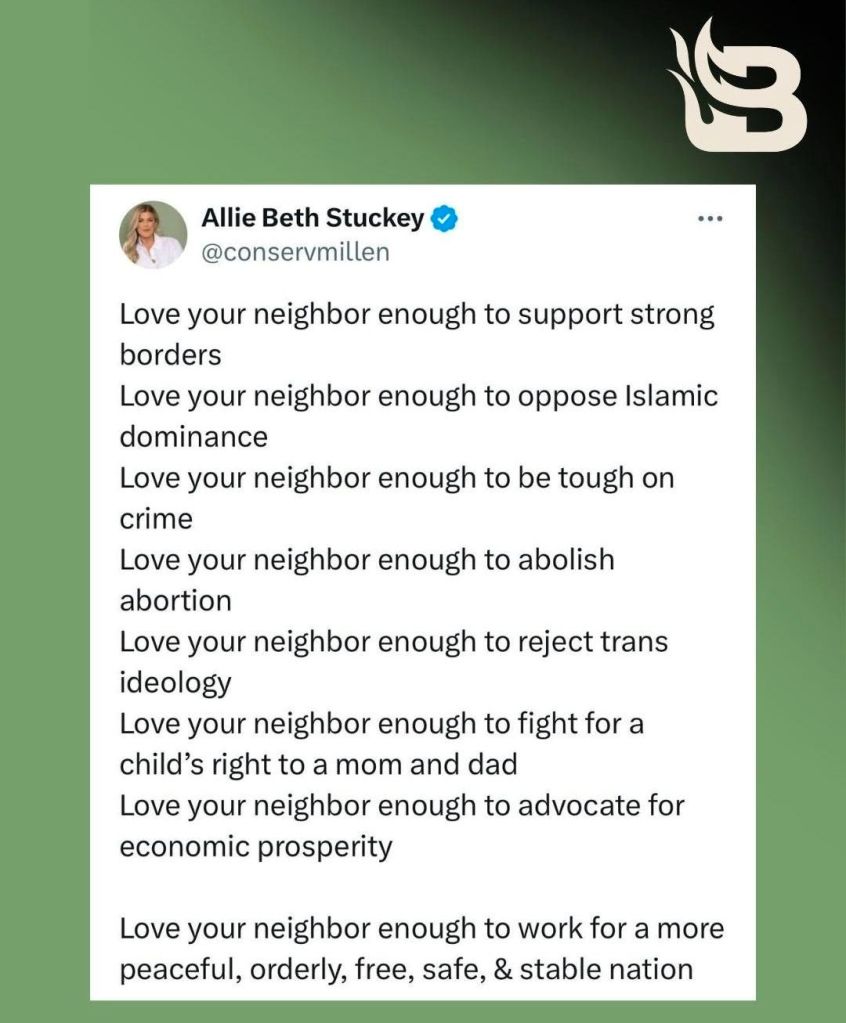
    A screenshot of a facebook post from @conservmillen that responds to Jesus' "Love thy neighbor" charge with MAGA talking points. It ends with the statement, "Love your neighbor enough to work for a more peaceful, orderly, free, safe, & stable nation."

    I keep seeing Christian Americans using Christ to try and justify their policy preferences. Tonight I noticed this piece of propaganda as I doom-scrolled. The dissonance in the last line jumped out at me. “Love your neighbor enough to work for a more peaceful, orderly, free, safe, & stable nation” (emphasis mine).

    The more order we have, the more safety, the more stability, the less freedom we have. I think we should at least recognize the trade-offs. When the right speaks of safety and stability, they usually mean law and order, being “tough on crime”, and, if Sean Duffy speaks for conservative values, no pajamas on planes.

    There are trade-offs on the left as well. When I talk about safety and stability, I’m usually referring to an FDR-style freedom from want, from hunger, from illness. Of course there is a trade-off: wealthy people have slightly less freedom with their money (though they benefit from the same freedom from want that everyone else does).

    I worry that “safety and stability” in the context of an attack on the Guard will mean more military in our streets, more surveillance of our daily lives, more internment and deportations of immigrants, and more policing of our thoughts and words.
  • Letter to my Senators: DOGE

    I hope you’ll agree with me that protecting Hoosiers’ personal data is of paramount importance. Assuming that is true, can you please tell me what you’re doing to hold the Department of Government Efficiency to account? I have serious concerns about un-vetted 20-year-olds gaining access to our government’s payment systems and taxpayer information. Their activities at Treasury also make them prime targets for recruitment by our adversaries.

    What are you and Congress doing to ensure 1) the security of our sensitive data, and 2) that DOGE employees are loyal to the United States and not to their own bank accounts? The fact that you have flip-flopped on Tulsi Gabbard’s nomination makes me doubly concerned about your commitment to national security. I don’t understand why you and other members of Congress have chosen to stop exercising your oversight powers.

    Finally, your office used to respond to these emails with, at the very least, form-letter language addressing the “Message Topic”. I have written several times this term requesting a response, and have yet to hear from you. You are my voice in the Senate: I need to know that you acknowledge my concerns, and consider them as you make decisions affecting me and my family.

  • An ode to policy

    An ode to policy

    Congratulations, America. You’ve gotten the policy-driven presidency you said you wanted. Let’s see what you’ve won:

    We’re about to find out if Walmart can pay a 200% tax on everything it imports and still keep those low, low prices. We’re gonna see what happens to the cost of food when we deport our cheap agricultural labor force. Watch what happens to affordable housing after we deport 1/3 of this country’s construction workers.

    I’m personally excited to see whether I get turned away from a public ladies’ room because the sex police decide I’m not feminine enough.

    When private health insurance companies are no longer constrained by the government (of the people) to meet the needs of all Americans, let’s see what happens to the cost of premiums. To the types of cancer treatments that are available under low-cost plans. We’ll watch as people change employers, and therefore health plans, and find out that their diabetes is now considered a pre-existing condition and that they’ll have to pay for related treatment on their own.

    How much will your kids’ dentist visits cost when non-fluoridated water isn’t keeping their teeth from rotting?

    Let’s see how many pregnant people die in emergency rooms because the right of their state’s legislature is more valuable than their right to life.

    Let’s count down the days until Ukraine is no longer a sovereign nation.

    How many new jobs will we suddenly lose when we abandon the microchip factories currently under construction?

    I’m going to be tracking these policy benchmarks. Will you be paying attention to how they affect the real world?

  • The argument against the argument against Harris – A white woman’s primer

    The argument against the argument against Harris – A white woman’s primer

    Most of the negative reactions to Kamala Harris’ presidential candidacy (with at least one notable exception) have landed in two camps:

    Camp 1 (Republicans): Kamala’s a terrible black woman who didn’t earn the nomination!

    Camp 2: (Democrats): They’re going to say Kamala’s a terrible black woman and that she didn’t earn the nom! (What do we dooooo?!)

    Let’s review how both arguments are deployed in bad faith, and how to start pushing back.against them.

    “She didn’t earn the nomination,” aka “Democrats scrapped the will of the voters”

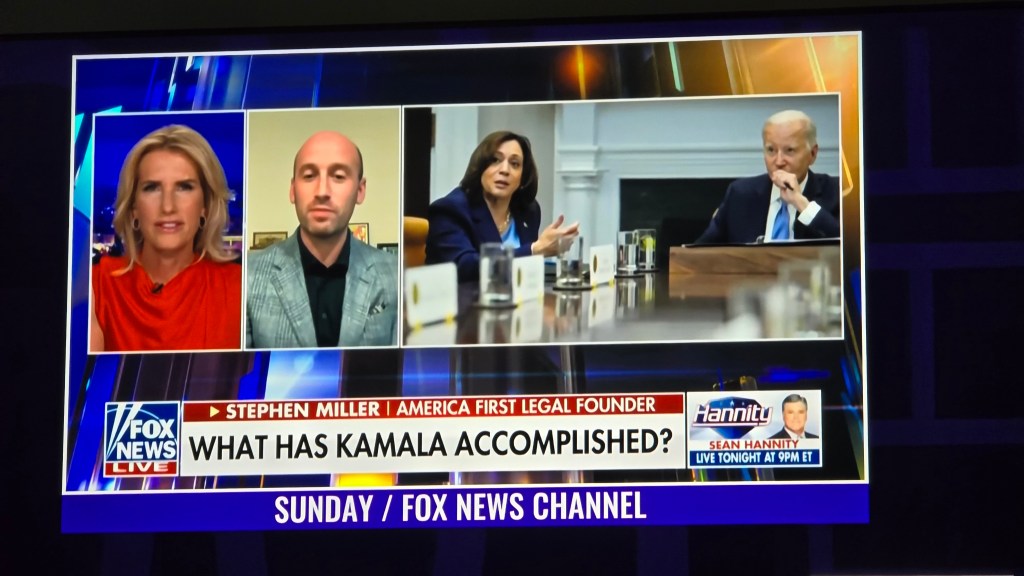
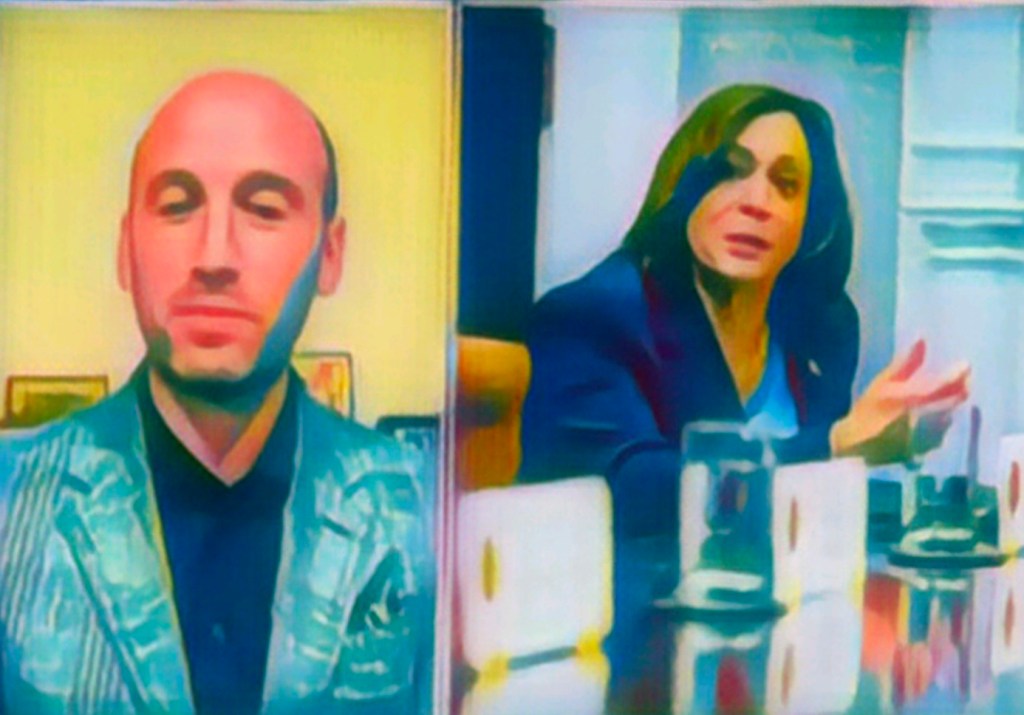
    Stephen Miller whining on behalf of Democratic primary voters who “filled in circles!”

    For the people bemoaning the lack of a democratic process here, how democratically have your last presidential candidates been chosen? Was Biden your first choice when the last presidential primary began? Was he your second? Or even third?! Set aside the fact that it takes an ungodly amount of money and connections to even enter a primary…the candidate is usually chosen by the time the 3rd or 4th state primary rolls around.

    My state’s primary is in May. In 2020, I wanted Warren, but there was no chance I was ever going to cast a meaningful vote for her. So until we have a national one-day primary, miss me with your “disrespecting the primary voters” BS. This was 14 million voters out of the coalition of 81 million that elected Biden to office. Voting for him unopposed. I was one of them. But that’s less than 20% of his electorate, and less than 10% of the electorate overall. Once he declared his candidacy for a second term, there was no real choice for voters. I didn’t hear many people complaining about the legitimacy then.

    “She’s a terrible black woman,” aka misogynoir

    We have to fight it everywhere we see it. Periodt.

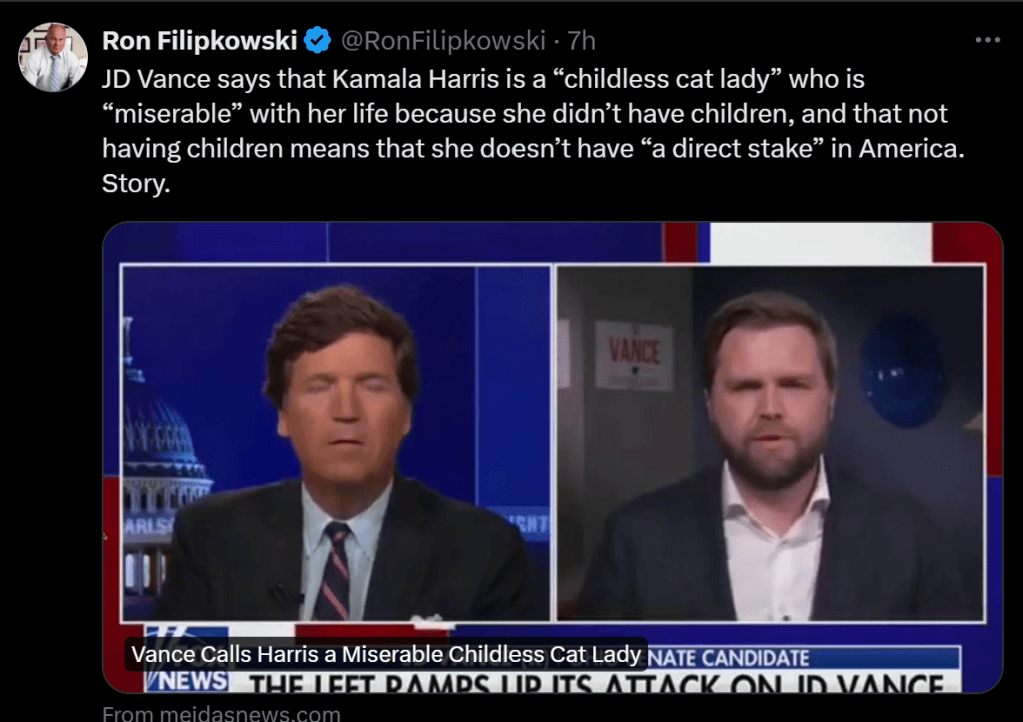
    Debunk stupidity about childfree women. Why someone does or doesn’t have children is none of your damned business. (Side note, I personally find living a childfree life very not miserable.) Living in America gives you a direct stake in America. If Vance’s statement were remotely true, they’d praise Joe Biden for being a family man acting on behalf of America’s future. Instead, they bludgeon him with his strong paternal values to bloody him as corrupt. This is not a serious, good-faith criticism. We have to call it out.

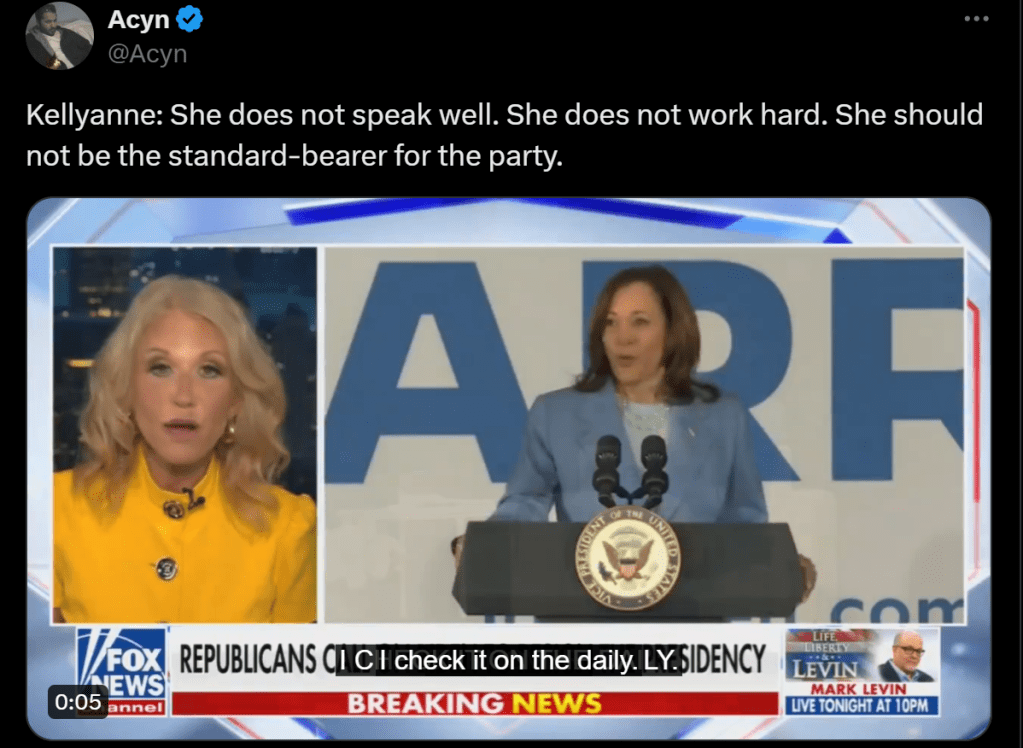
    Push back on racist tropes. We white people have diminished people of color since before the founding as stupid and lazy. Primitives not worthy of citizenship or of meaningful participation in society. Every time we credit a Black person (often with a whiff of surprise) for being “so articulate,” we reveal this racist inheritance. Kellyanne’s “She does not speak well” is just flipping the “compliment” back to the historical status quo. Then she doubles down with the laziness trope, “She does not work hard.” Kellyanne’s arguments appeal to her audience’s racism. And we have to call it out.

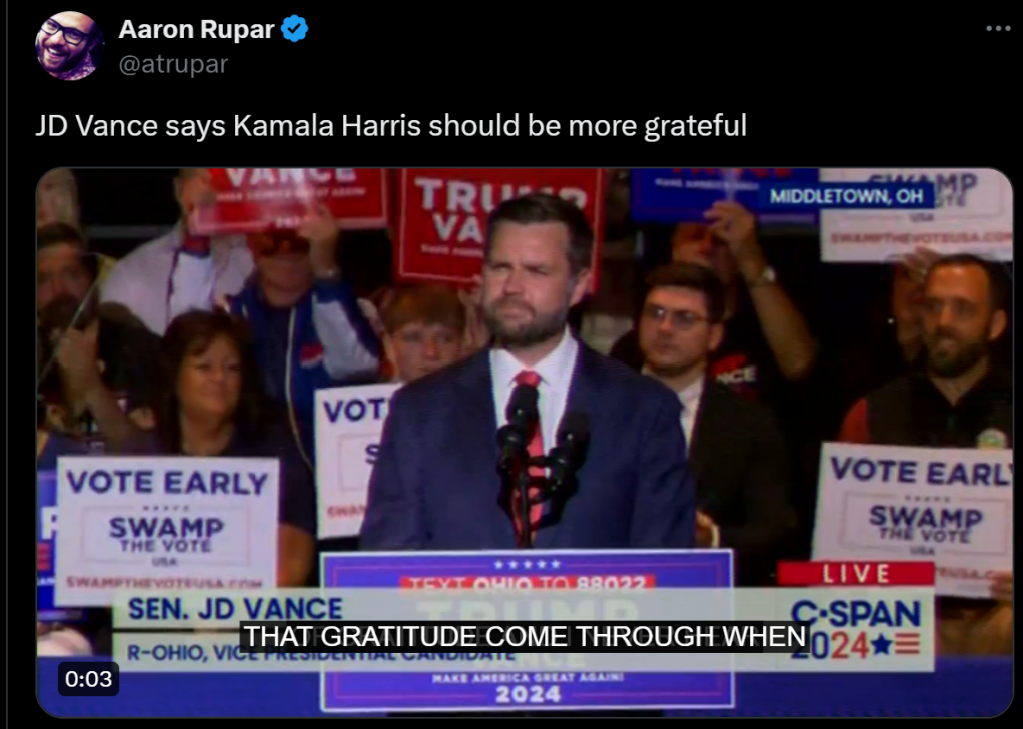
    Dispense with garbage that black people and immigrants are ungrateful. JD Vance plays to his audience’s self-superiority by positing that he’s grateful to his country, and that you have a responsibility to give back. In 2019, Kamala Harris literally started her campaign talking about how much she loves this country, and how she feels a responsibility to give back. JD Vance just isn’t listening. Instead, he’s stirring up anti-immigrant, anti-black sentiment towards “ungrateful” freeloaders who do nothing for their paychecks. Our work as white people in this campaign it to call it out.

  • My Political Crossroads

    Daily writing prompt
    How have your political views changed over time?

    My political crossroads came early – at age 13. Up till then, I had pretty much done like most kids: taken the lead on politics from my parents. My folks were WASPy, middle-class Republicans in the 70s and 80s. Politics as such was rarely discussed, though my earliest political memories include telling Jimmy Carter jokes among the other kids in our family-friend group.

    Two running currents in my life intersected in 1984: one was the Reagan/Mondale presidential race. The other was my own developing moral code, which was influenced heavily by viewing the 1982 film Gandhi, and by studying the Gospel in my church confirmation class.

    I considered myself pro-Reagan, or as pro-Reagan as a sheltered 13-year-old white kid with no context could consciously consider herself. In our social studies class’s pre-election debate, I was enthusiastically on Team Reagan. Even at that age, I sensed and enjoyed the feeling of power on the incumbent side. I also remember the importance of rhetoric; even though we lost the mock debate on points, our teacher gave us credit for the persuasive delivery of our (admittedly) stupid arguments.

    At the same time, my study of Satyagraha and of the Gospel of Matthew, in particular, the Sermon on the Mount, were substantially influencing my worldview. My politics, previously an unconscious performance of power, crystalized around compassion, love of the neighbor, and non-violence. By the next general election, I was a bleeding-heart, flaming lib. While I continue to interrogate liberal and progressive politics through the lens of my values, I have never found the need to turn back.